Short answer: an operating light that is dead, dim, flickering or will not stay put has a short list of usual causes. On a halogen light the bulb is the first suspect; on an LED light it is the switch, sensor or driver. The practice can check the supply, the controls and the mode setting from the outside. Bulb replacement is only for staff where the manufacturer's instructions make it a user task. Everything else is for an engineer.
Halogen and LED heads: what is inside
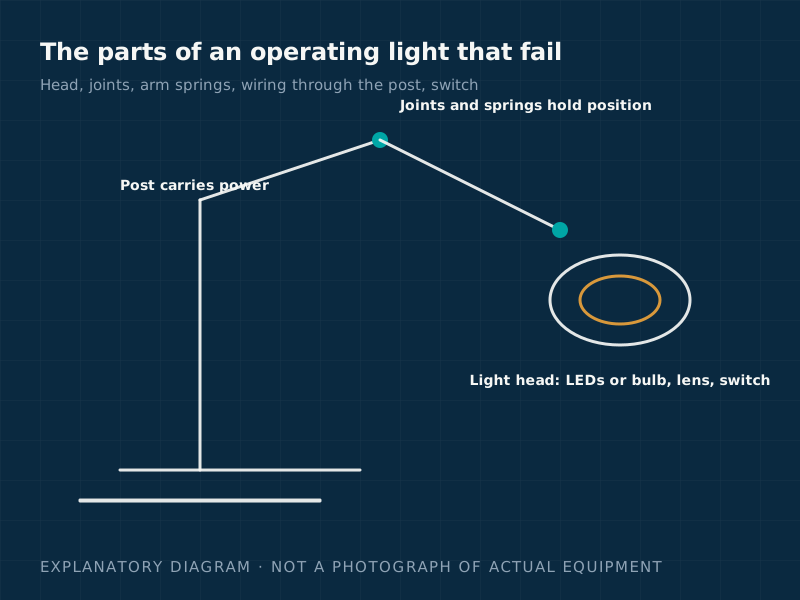
Older lights use a halogen bulb behind a reflector and a heat filter, fed by a transformer in the chair or the ceiling mount. The bulb is a consumable, and on many models the manufacturer expects it to be replaced by the user following the instructions supplied with the light. It runs hot, so the head needs time to cool before anything is touched.
LED lights use an array of diodes on a heat sink, driven by an electronic driver that regulates current and, on most models, provides dimming and a composite-safe mode. The LEDs themselves rarely fail early; when an LED light dies, the driver, the switch or the wiring through the arm is the more likely cause. There is no user-replaceable bulb, and nothing inside the head for the practice to check.
Checks in order
1. Is the unit powered?
Most chair-mounted lights are fed from the treatment centre. If the chair and delivery unit are dead too, the fault is the supply to the unit, not the light. Ceiling-mounted lights usually have their own switched spur; check it is on and the breaker has not tripped. A tripped breaker may be switched back on once; if it trips again, leave it off and report it.
2. Switch, touch pad or sensor
Lights are switched by a mechanical switch on the head, a membrane pad on the unit, a proximity sensor waved past, or the foot control. Try each control that the light supports. A sensor that responds only intermittently is often dirty or has a film of cleaning residue over it; wipe it as the manufacturer's cleaning instructions describe. A light that comes on from one control but not another has a fault in that control path, which is useful information for the engineer.
3. Halogen: the bulb
If the light is halogen and completely dead while the unit is lit, the bulb is the most likely cause. On many halogen lights the manufacturer treats bulb replacement as a user task and describes it step by step in the instructions supplied with the light. If your instructions do that, and someone in the practice has been shown the procedure, it can be done in the practice: switch the light off, isolate the unit, let the head cool fully, follow those instructions exactly, and fit only the voltage and wattage marked on the head or in the manual, handling the new bulb with its packaging or a clean cloth rather than bare fingers. A higher-wattage bulb overheats the head and can damage the reflector and the filter. If the instructions are not to hand, if the head does not release in the way they describe, or if any part of the head, filter or wiring looks damaged or discoloured, stop and call an engineer. A new bulb that fails quickly, or a light that is dim with a new bulb, points to the transformer or its connections, which is an engineer's job.
4. LED: driver and dimming
An LED light that flickers, comes on dim, or shows only some of its diodes usually has a failing driver or a loose connection in the arm. Check whether it is in a dimmed or composite mode: many lights have an amber or reduced-intensity setting that looks like a fault to anyone who did not select it. If it will not leave that mode, note it and report it. Do not open the head.
5. Cabling through the arm
The wiring to the head passes through each joint of the arm and flexes every time the light is moved. Over the years it can chafe, particularly at the joint closest to the head. The tell-tale is a light that flickers or goes off in certain arm positions and comes back in others. Note which positions, and leave the light where it works or switch it off. This is not something to investigate by moving the arm back and forth repeatedly; that can turn an intermittent fault into a dead short.
Symptom table
| Symptom | Halogen | LED |
|---|---|---|
| Completely dead, unit powered | Bulb; then fuse or transformer (engineer) | Switch, driver or fuse (engineer) |
| Dim | Wrong bulb, tired bulb, dirty reflector or filter, low supply | Dimmed or composite mode, driver |
| Flickers | Bulb not seated, loose connection | Driver, arm cabling |
| Works only in some arm positions | Arm cabling | Arm cabling |
| Some of the beam missing or uneven | Reflector damage, filter misaligned | Part of the array or its driver |
| Comes on then goes off after a while | Overheating: blocked vents, wrong bulb | Thermal protection in the driver |
| Will not switch off | Switch fault | Switch or sensor fault |
Lights that drift, drop or will not stay put
The arm on an operating light is balanced by springs and friction joints so that it stays where it is placed. When it drifts up, sinks down or swings on its own, the balance has changed. Causes include a worn friction pad, a spring that has lost tension, a loose clamp at the mount, or a heavier head fitted to an arm designed for a lighter one. Adjusting the balance is an engineer's job: the springs are under considerable tension and an incorrectly adjusted arm can move suddenly. Do not attempt to tighten joints yourself, and take particular care if a light is dropping towards the patient's position; park it away from the chair and report it.
Safety
- Halogen heads are hot for some minutes after use. Let them cool before any handling.
- Never operate a halogen light with the protective filter or cover missing; it limits heat and ultraviolet output at the patient.
- A light that smokes, smells hot or shows scorching around the head should be switched off at the supply if that is safe and not used until it has been checked. Do not continue using equipment you believe may be unsafe.
- Ceiling-mounted lights depend on their fixing. Any looseness at the ceiling plate is a reason to stop using the light immediately.
Replacing lights on older chairs
When a halogen light on an older chair fails repeatedly, or the manufacturer no longer supplies the head, an LED replacement head or a separate ceiling-mounted light is often practical. The questions to settle before choosing are whether the existing arm and mount can carry the new head, whether the chair's transformer output suits the new driver, and whether the surgery would be better served by a ceiling light that survives a future chair change. Those are questions we can answer at a service visit or survey rather than at the moment of failure.
When to stop and call an engineer
Stop and call if the light is still dead after the power and control checks, if a bulb change is not a user task on your light or you are unsure, if it flickers with arm position, if the arm drifts or drops, or if you have seen any sign of overheating. Use report a breakdown and say whether the light is halogen or LED, chair- or ceiling-mounted, and what you have already checked. Drivers, transformers, switches and arm cabling are routine dental equipment repairs; arm balance and head cleaning are part of dental chair servicing. Isolate any light that smokes, sparks or overheats, and do not continue using equipment you believe may be unsafe.
This article is general guidance for dental practices. It does not replace the manufacturer's instructions for your specific equipment, is not a statement of your regulatory position, and is not a substitute for an engineer examining the machine. If equipment smokes, sparks, overheats or leaks near electrical parts, isolate it and do not use it until it has been checked.
Sources
- Manufacturer operating and maintenance instructions for the installed operating light — Equipment manufacturer (accessed 9 September 2026)
- Electricity at Work Regulations 1989: guidance on regulations (HSR25) — Health and Safety Executive (accessed 9 September 2026)
- Managing medical devices: guidance for health and social care organisations — Medicines and Healthcare products Regulatory Agency (accessed 9 September 2026)