Short answer: repair a dental chair while the fault is isolated and identifiable, parts are available, and the chair is structurally sound and otherwise reliable. Plan its replacement when faults repeat and each repair is larger than the last, when parts are obsolete or on long lead times, or when the unit no longer suits the way the surgery works. Make the decision on the chair's history and condition, not on the day it fails.
Start with the facts you already have
Most practices can answer these from the asset register and the service folder in ten minutes, and the answers usually settle the question:
- Age and history. When was the chair installed, and what has been done to it since? Three unrelated faults over ten years is a reliable chair. Three related faults in a year is a pattern.
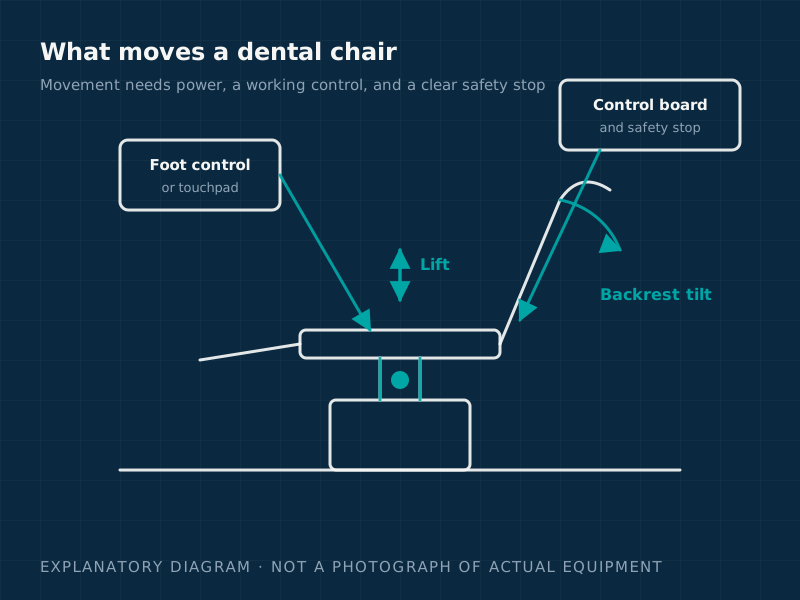
- What has failed this time. A foot control, a valve, a hose, a switch, a light bulb, an actuator: these are components. A cracked base casting, a corroded frame, a control board that the manufacturer no longer makes: these are the chair.
- Parts availability. Are parts available from the manufacturer or a reputable supplier, and how quickly? Many manufacturers state how long they support a model after production ends.
- Structural and electrical condition. Is the upholstery intact and cleanable? Is the base sound? Has the chair passed its electrical safety checks without comment?
- Fit with the surgery. Does the delivery system, the assistant's side and the light still suit the dentistry being done in that room? A chair can be reliable and still be the wrong chair.
Signs that repair is the right call
- A single, identifiable fault with a known part.
- The part is available and the repair can be done in one visit.
- The chair has a good service history and its movements, water and air are otherwise reliable.
- Upholstery, covers and the base are sound, or can be renewed economically.
- The practice has no plans to change the surgery layout or the way the room is used.
Signs that replacement should be planned
- The same chair keeps taking the surgery out of use, and each repair is bigger than the last.
- Parts are obsolete, sourced second-hand, or on lead times that would close the room for weeks.
- The manufacturer has withdrawn support for the model.
- Repair spend over the last year or two is approaching a meaningful share of the cost of a replacement, once downtime is counted.
- The delivery system, light or assistant's side no longer supports the clinical work, and the chair cannot be upgraded.
- Upholstery cannot be kept clean and intact, which is an infection-control issue as well as a cosmetic one.
- The chair cannot meet a current requirement the practice needs — for example a patient-weight rating, wheelchair access, or a waterline arrangement the practice has adopted.
A factor-by-factor framework
| Factor | Favours repair | Favours replacement |
|---|---|---|
| Nature of fault | Component: valve, switch, hose, control, motor | Structural, corrosion, obsolete electronics |
| Fault history | Isolated, unrelated faults | Recurring or escalating faults |
| Parts | Available from manufacturer, short lead time | Obsolete, second-hand only, long lead time |
| Manufacturer support | Model still supported | Support withdrawn or ending |
| Downtime | One planned visit, then the room is back in use | Repeated closures, unpredictable |
| Condition | Base, frame, upholstery and wiring sound | Any of these compromised |
| Surgery fit | Suits current and planned use | Limits the dentistry or the workflow |
| Cumulative spend | Modest against replacement | Approaching a meaningful share of replacement |
| Practice plans | Room unchanged for the foreseeable future | Refurbishment, relocation or sale planned |
No single row decides it. Two or three rows in the right-hand column, particularly parts and fault history, usually do.
Thinking about cost without fooling yourself
The repair quotation is the visible number. The others are downtime — a closed surgery is lost income and rebooked patients — the management time each breakdown consumes, and the risk of a failure during treatment. Against replacement, the visible number is the chair; the others are installation, any changes to services and cabinetry, disposal of the old unit, staff familiarisation and a closed room during the changeover. Putting both sets side by side, over the period you expect to keep the practice, is more useful than comparing the two visible numbers. We do not publish rules of thumb because the right answer depends on the chair, the surgery and the practice's plans.
Parts and obsolescence
A chair with a sound frame and hydraulics can often be kept in service well beyond its original expectation if the control electronics and consumables are available. The reverse is also true: a chair that looks new can become unsupportable when a proprietary control board is withdrawn. Before committing to a large repair on an older chair, ask the engineer what else on that model is known to be scarce. A repair that fixes today's fault on a chair whose next likely failure has no part available is a poor use of money.
Planning a replacement properly
Replacement done well is a project, not an emergency purchase.
- Survey the room. Floor loading, position of the floor box, air, water, drain, suction and electrical supplies, and whether they meet the new chair's installation requirements. Older installations frequently need service changes, and the electrical work must comply with BS 7671.
- Choose on requirements. Clinical needs, patient population, left- or right-handed working, delivery style, integration with the light and monitor, waterline arrangement, and the manufacturer's support position.
- Schedule the changeover for a closed session, with services prepared in advance so that installation, functional checks and manufacturer commissioning where the manufacturer requires it happen in one window.
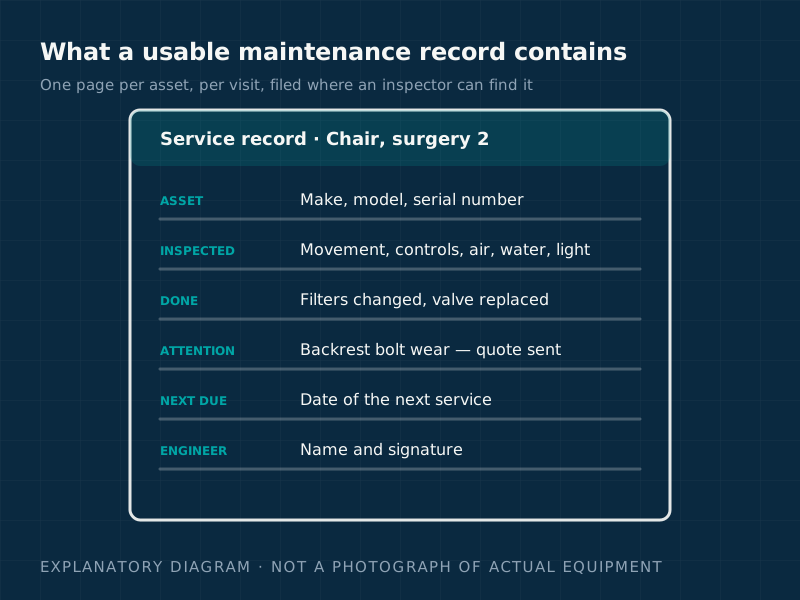
- Handover records. Installation record, functional checks, manufacturer's instructions, the new asset added to the register and its first service date set. This is where the chair's maintenance history starts.
- Dispose of the old chair correctly. Have it decontaminated, and have any amalgam-contaminated parts and the electrical equipment taken through a route licensed for hazardous and electrical waste, keeping the consignment paperwork with the practice's waste records.
Interim measures
If the decision is to replace but the new chair is weeks away, a modest repair to keep the room open can still be the right choice, provided the chair is safe. A chair that cannot hold position, has exposed wiring, or has a failed safety switch is taken out of use, not kept going with a workaround. Do not continue using equipment you believe may be unsafe.
Doing it across the whole practice
A repair-or-replace decision made chair by chair, at the moment of failure, is the expensive way. A condition assessment of every chair, compressor and suction plant against its service history turns the same decisions into a planning schedule: which assets to maintain, which to budget for and in what order. That is what a practice engineering survey is for, and equipment records and lifecycle planning is where the schedule lives afterwards.
When to stop and call an engineer
Stop using a chair that creeps, will not hold position, shows exposed wiring or has a safety switch that no longer works, and call. If a chair has failed, report a breakdown and ask for a written assessment alongside the repair quotation: the fault, the condition of the chair, and what else is likely to need attention. Chairs that are worth keeping are kept going by dental chair servicing. When the answer is replacement, equipment supply and installation covers the survey, the services and the changeover: plan equipment replacement with us before anything is ordered. Isolate any chair that smokes, sparks, overheats or leaks near its electrics, and do not continue using equipment you believe may be unsafe.
This article is general guidance for dental practices. It does not replace the manufacturer's instructions for your specific equipment, is not a statement of your regulatory position, and is not a substitute for an engineer examining the machine. If equipment smokes, sparks, overheats or leaks near electrical parts, isolate it and do not use it until it has been checked.
Sources
- Manufacturer operating and maintenance instructions for the installed chair or treatment centre — Equipment manufacturer (accessed 9 September 2026)
- Managing medical devices: guidance for health and social care organisations — Medicines and Healthcare products Regulatory Agency (accessed 9 September 2026)
- Regulation 15: Premises and equipment — Care Quality Commission (accessed 9 September 2026)
- Requirements for Electrical Installations, BS 7671 (IET Wiring Regulations) — Institution of Engineering and Technology (accessed 9 September 2026)