Short answer: if only one surgery has weak suction, the cause is almost always at the chair: the chairside filter, a hose, a holder valve or a blocked tip. If every surgery is weak, the cause is central: the pump, its filter, the amalgam separator, the drain or the main line. Staff can clean the chairside filter and check hoses, following the practice's infection-control procedure. Beyond the chairside filter, stop and call an engineer.
How the system works, briefly
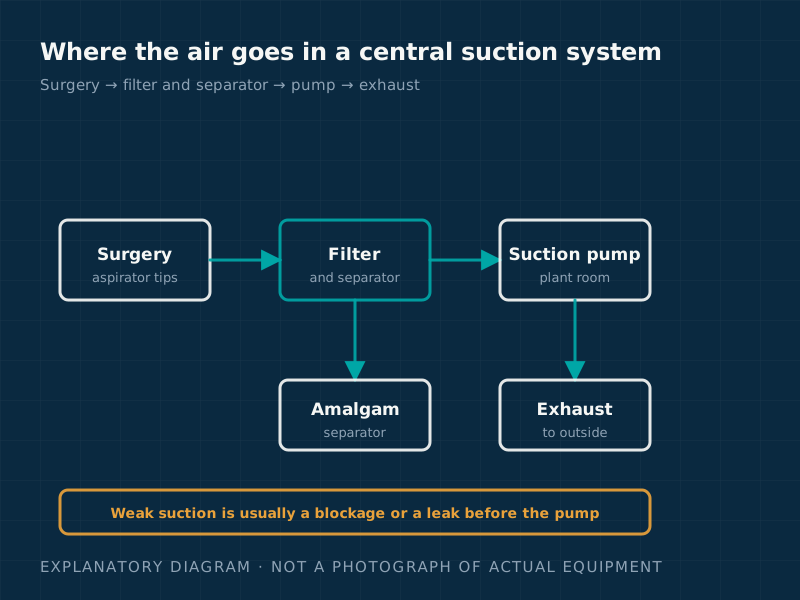
A suction system pulls air, water and debris from the chairside through hoses and pipework to a central plant, which separates the liquid and solids from the air, passes the liquid through an amalgam separator where one is fitted, and discharges the air to atmosphere and the liquid to drain. Wet systems use a liquid-ring or similar pump that handles the fluid directly; dry systems separate air from liquid at each chair or in a central separator, so the pump only ever handles air. Both have a chairside filter, at least one central filter, a pump and a drain, and each of those is a place where suction is lost.
Step 1: one surgery or all?
Ask every room. If two units share a plant, ask both. If the suction is weak everywhere, go to the plant room and look and listen. If it is weak in one room, stay there.
One surgery affected
- Chairside filter or trap blocked. The most common cause by a distance. Solids collect here by design and the filter is meant to be cleaned or replaced on a schedule. A filter that fills faster than usual suggests the room is doing more aerosol-generating work, or that a filter earlier in the line is missing or damaged.
- Hose collapsed, split or kinked. A suction hose that has aged goes soft and can collapse under vacuum, especially at the point where it hangs from the holder. A split hose lets air in and drops the vacuum at the tip.
- Selector valve or holder valve not opening fully. The valve that opens when the hose is lifted from its holder can stick, corrode or be blocked by debris.
- Tip or handpiece blocked. The obvious one; the aspirator tip or the saliva ejector body can be blocked with gauze or cured material.
- Chairside separator or cuspidor drain. On units with a chairside separator or a cuspidor connected to the suction line, a full or blocked separator drops the vacuum for that chair only.
- Air leak at the chair. A perished O-ring in a hose coupling, or a hose not pushed fully home, lets air in before the tip.
All surgeries affected
- Pump not running. Power, isolator, thermal overload or a control fault. The plant room will be quiet when it should not be.
- Pump running but weak. A wet pump starved of its service water, a worn impeller, or a dry pump with a blocked inlet filter.
- Central filter or bacterial filter blocked. These protect the pump and clog gradually. Weak suction that has been getting worse for weeks everywhere is usually this.
- Amalgam separator full or in alarm. Separators have a container that fills and, on most models, an alarm that warns before it does. Some systems reduce or stop suction when the container is full so that untreated waste cannot get past the separator.
- Drain or exhaust blocked. If the liquid cannot leave, the separator fills; if the air cannot leave, the pump cannot pull.
- Air leak in the main line. A hose off a fitting, a cracked pipe from building work, or a chair left with a hose off its holder in an unused room, all reduce vacuum for every other room.
- Undersized plant. A practice that has added surgeries to a pump sized for fewer will have acceptable suction in one room and poor suction when all are in use.
Amalgam separator alarms
If the separator is showing an alarm, it is telling you either that the container is nearly full, that it is full, or that it has a fault. Note which, and do not clear or silence the alarm to get through a session. A full container needs changing by someone trained to do it, with the used container consigned as hazardous waste under the practice's arrangements with a licensed carrier; the Environment Agency's guidance on hazardous waste applies to amalgam. Running a separator past full risks discharging amalgam to drain and can stop the suction entirely.
Symptom table
| Symptom | Most likely | Practice action |
|---|---|---|
| Weak in one room, fine elsewhere | Chairside filter, hose, holder valve | Clean the filter and check the hoses per your procedure; if no better, report |
| Weak in one room, worse when second hose lifted | Hose or valve leak at that chair | Report |
| Weak everywhere, slowly worsening | Central filter, separator filling, pump wear | Check the separator indicator; report |
| No suction anywhere, plant silent | Pump power or overload | Check the isolator is on; report |
| No suction, plant running loudly | Blocked inlet, exhaust or drain; air leak | Listen for a hiss; report |
| Separator alarm on | Container full or fault | Note the alarm; leave it showing; arrange the change |
| Gurgling, fluid backing up at chair | Blocked drain or line, wet system fault | Stop using that room; report |
| Smell from plant room | Drain trap dry, filter overdue, separator | Report |
Infection control and staff safety
Everything on the suction side of a chair is contaminated. Chairside filters, traps and hoses are designed to be handled by trained staff following the practice's infection-control procedure, with appropriate personal protective equipment and the cleaning and disinfection routine set out in HTM 01-05 and the manufacturer's instructions. Beyond the chairside filter, stop. The central filter, the separator and the pump are engineer territory, both for safety and because opening the plant incorrectly can release aspirated fluid. If the plant room smells of burning, the pump is hot, or fluid is leaking near the electrics, isolate the plant if that can be done safely and do not run it until it has been examined. Do not continue using equipment you believe may be unsafe.
Can you keep treating?
Only the clinician can judge whether suction is adequate for a given procedure. If it is not adequate for safe treatment or aerosol control, take that room out of use and follow your local procedure. A room with weak suction may still be usable for some examinations; it is not usable for procedures that depend on high-volume aspiration.
What to tell the engineer
How many rooms are affected; whether it is weak or absent; whether it has faded or failed suddenly; what the separator indicator shows; whether the pump is running and how it sounds; and what you have already cleaned. If the plant has a vacuum gauge, the reading with all hoses in their holders and the reading with one hose lifted are both useful.
When to stop and call an engineer
Stop and call if suction is weak in more than one room, if it does not recover after the chairside filter has been cleaned, if the separator is in alarm, if fluid is backing up at a chair, or if the plant is silent, noisy or smelling. Use report a breakdown with the details above. Pumps, filters, valves, hoses and separator changes are covered under dental suction and amalgam separators, and chairside components under dental equipment repairs. Suction that is slowly getting worse across the practice is one of the clearest signs that central filters and separator changes are overdue for a planned schedule. Isolate any plant that smokes, sparks, overheats or leaks near its electrics, and do not continue using equipment you believe may be unsafe.
This article is general guidance for dental practices. It does not replace the manufacturer's instructions for your specific equipment, is not a statement of your regulatory position, and is not a substitute for an engineer examining the machine. If equipment smokes, sparks, overheats or leaks near electrical parts, isolate it and do not use it until it has been checked.
Sources
- Manufacturer operating and maintenance instructions for the installed suction unit and amalgam separator — Equipment manufacturer (accessed 9 September 2026)
- Health Technical Memorandum 01-05: Decontamination in primary care dental practices — NHS England (accessed 9 September 2026)
- Dispose of hazardous waste: guidance for businesses — Environment Agency (GOV.UK) (accessed 9 September 2026)
- Electricity at Work Regulations 1989: guidance on regulations (HSR25) — Health and Safety Executive (accessed 9 September 2026)