Short answer: CQC inspectors look for evidence that the equipment in a dental practice is suitable for its purpose, properly maintained and safe to use — the substance of Regulation 15, "Premises and equipment", of the Health and Social Care Act 2008 (Regulated Activities) Regulations 2014. They are not looking for a plaque or a "certificate of compliance", because no such thing exists. The evidence is a set of records that can be read in a minute.
What Regulation 15 asks
In plain terms: the equipment used to deliver care must be clean, secure, suitable for the purpose, properly used, properly maintained and appropriately located. "Properly maintained" is the part that bears on dental engineering. It means maintained in line with the manufacturer's instructions and with the relevant statutory requirements, and it means being able to show that this is the case. The duty sits with the registered provider. A maintenance contractor can help the practice meet it; the contractor cannot meet it for the practice.
What inspectors typically ask to see
Inspection is not a paperwork audit and inspectors vary, but the equipment records that come up repeatedly are:
- An equipment register. A list of the significant equipment in the practice — chairs, compressors, suction plant, autoclaves, washer-disinfectors, X-ray sets, handpieces by group — with make, model, serial number, location and date of installation.
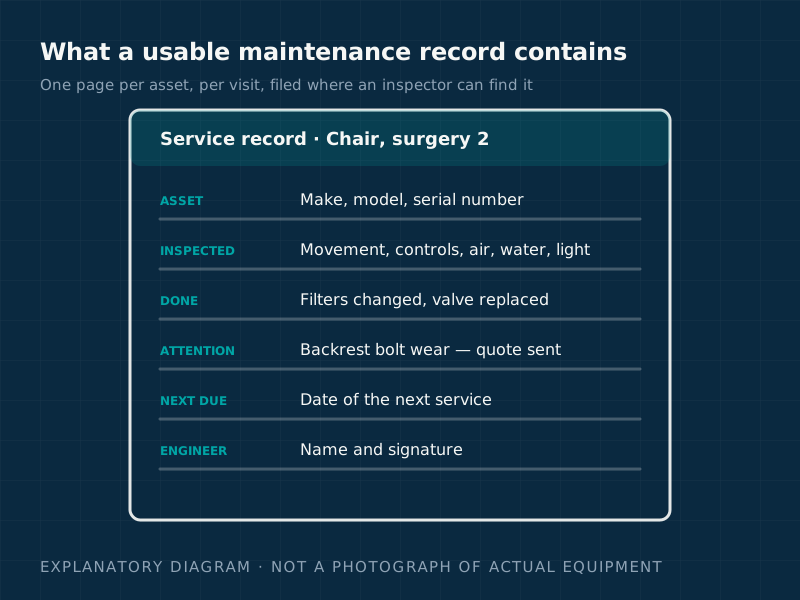
- Service records for each asset. The report from the last service, showing what was done, what was found, and when the next service is due.
- Statutory examination records where they apply. For the compressor system, the written scheme of examination and the report of examination under PSSR 2000. For X-ray equipment, the records required under IRR17 and IR(ME)R, including the arrangements with the radiation protection adviser and medical physics expert.
- Decontamination records. Validation, periodic testing and daily test records for autoclaves and washer-disinfectors, as set out in HTM 01-05.
- Electrical safety records. The periodic inspection report for the fixed installation and the records for in-service inspection and testing of portable equipment.
- Water safety records. The legionella risk assessment and the dental unit waterline management records.
- Waste records. Consignment notes for amalgam and other hazardous waste.
- A list of what is outstanding. Defects reported, actions agreed, who owns them and when they are due.
The last item is the one most often missing, and it is the one that most reassures an inspector, because it shows the practice knows its own position.
Service report, examination report, certificate: not the same thing
| Document | Who issues it | What it evidences | What it does not evidence |
|---|---|---|---|
| Service report | Maintenance engineer | Maintenance carried out to the manufacturer's schedule on a given date | Statutory examination; validation; calibration; the practice's overall regulatory position |
| Report of examination (PSSR) | Competent person | The pressure system was examined to the written scheme and is safe to continue in use until the stated date | That the compressor has been serviced |
| Validation and test records (HTM 01-05) | Test person / practice | Decontamination equipment performs as required | General maintenance of the device |
| Electrical installation condition report | Electrician | Condition of the fixed wiring on the date | Safety of the equipment plugged into it |
| Calibration certificate | Calibration provider | A measuring instrument reads correctly against a reference | That the instrument is otherwise maintained |
| Engineering survey or condition report | Dental engineer | Observed condition and recommended actions at a point in time | Any statutory examination or audit |
A practice that files a compressor service report as its "PSSR" has a gap it does not know about. A practice that files a functional check of an autoclave as a validation has another. The names matter because the duties are different.
Common gaps
- Service reports that do not identify which asset they relate to, so nobody can prove which chair was serviced.
- Equipment maintained by several suppliers with no single view of what is due when.
- Due dates that exist only in a supplier's diary, not the practice's.
- A statutory examination confused with a service, or a service assumed to include it.
- Defects noted on a service report that were never actioned, and no record of the decision not to.
- Equipment on the register that has been disposed of, and equipment in use that is not on it.
- Records held by a previous practice manager, in a previous format, in a drawer.
Organising the evidence
A simple structure works better than a sophisticated one that nobody maintains.
- One entry per asset in the register, with its own identifier written on the asset.
- One folder per asset, physical or digital, holding the manufacturer's instructions, the installation record, every service report, every examination report and every defect note.
- One evidence table for the practice: a single page listing each requirement, the current evidence, when it was last completed, when it is next due and who is responsible.
- One actions list: every outstanding defect and recommendation, with an owner and a target date, reviewed at a fixed interval.
An evidence table, in outline
| Requirement | Asset(s) | Evidence | Last done | Next due | Responsible |
|---|---|---|---|---|---|
| Chair servicing | Surgery 1–4 chairs | Service reports | date | date | Practice manager / engineer |
| Compressor servicing | Compressor | Service report | date | date | Practice manager / engineer |
| Pressure system examination | Compressor and receiver | Written scheme; report of examination | date | date | Practice manager / competent person |
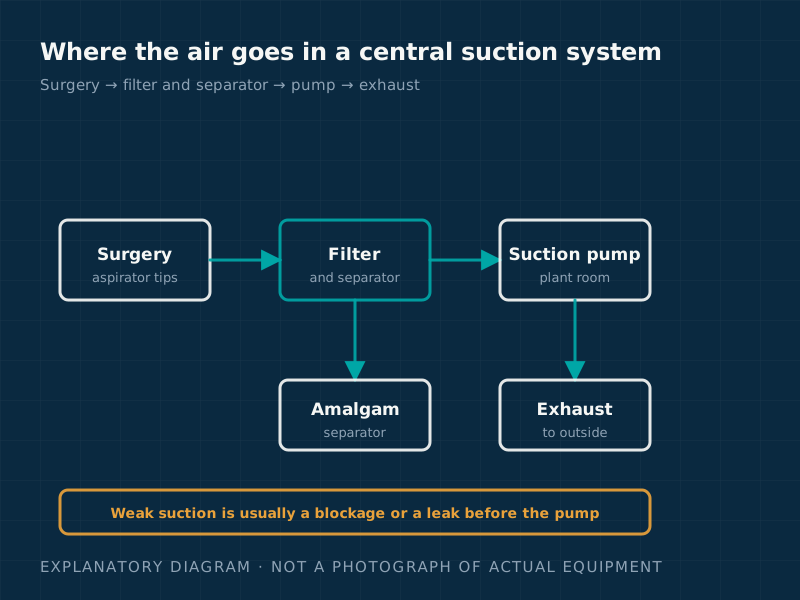
| Suction and separator | Suction plant | Service report; consignment notes | date | date | Practice manager / engineer |
| Decontamination validation | Autoclave, washer-disinfector | Validation and test records | date | date | Decontamination lead / test person |
The point of the table is not the format. It is that anyone — a new manager, a locum, an inspector — can see the practice's position without opening a folder.
What stays with the provider
The registered provider is responsible for ensuring equipment is safe and suitable, for keeping the records, for acting on defects and for meeting the statutory duties that sit alongside Regulation 15. Dynamo Dental helps practices organise relevant maintenance records and identify next actions within the agreed scope. The practice remains responsible for ensuring its regulatory duties are met. We do not carry out CQC inspections, we do not audit against the regulations, and we do not tell a practice that its regulatory position is settled.
Where Dynamo Dental helps
Our service reports are matched to the asset by serial number and state the next due date. Under DynamoCare, the practice sees due dates for the equipment in scope and receives remedial recommendations in writing. Where a practice wants its records put in order from scratch, a practice engineering survey establishes the asset register, apparent condition, known service information and the gaps, and equipment records and lifecycle planning turns that into an evidence table and an actions list the practice owns. The survey is an engineering baseline; it is not a statutory inspection or an independent audit.
When to stop and call an engineer
Records describe what is safe; they do not make it so. If a service report or a report of examination has flagged a defect that has not been dealt with, stop using that equipment where the report says to, use report a breakdown to get it seen, and see dental equipment repairs for how the defect gets closed. If you cannot say when each chair, the compressor and the suction plant were last serviced, or you do not know whether a written scheme of examination exists for the compressor, start with equipment records and lifecycle planning or book an engineering survey. Isolate any equipment that smokes, sparks, overheats or leaks near its electrics, and do not continue using equipment you believe may be unsafe.
This article is general guidance for dental practices. It does not replace the manufacturer's instructions for your specific equipment, is not a statement of your regulatory position, and is not a substitute for an engineer examining the machine. If equipment smokes, sparks, overheats or leaks near electrical parts, isolate it and do not use it until it has been checked.
Sources
- Regulation 15: Premises and equipment — Care Quality Commission (accessed 9 September 2026)
- Guidance for dental providers — Care Quality Commission (accessed 9 September 2026)
- Safety of pressure systems: Pressure Systems Safety Regulations 2000 Approved Code of Practice (L122) — Health and Safety Executive (accessed 9 September 2026)
- Health Technical Memorandum 01-05: Decontamination in primary care dental practices — NHS England (accessed 9 September 2026)