Short answer: air and water reach a handpiece through four stages: the plant (compressor, mains or bottle), the room (isolation valves), the unit (master switch, selectors, filters) and the instrument (coupling, tip, tubing). Supply that stops at one stage leaves everything downstream dry. First ask whether one surgery or all are affected, then check the stages in order, from the outside, and call an engineer for anything past an open valve or a seated coupling.
Before you start: where the practice stops
Everything below is done by looking, listening, reading a gauge, operating the switches and valves that are there for the user, and swapping instruments. The compressor is a pressure system and an electrical machine: the practice does not adjust its pressure switch, regulator or safety valve, does not loosen anything on the receiver or the pipework, and does not take covers off the compressor or the unit. If any equipment smells of burning, is hot, sparks or trips its supply, switch it off at the isolator if that is safe and call an engineer. Do not continue using equipment you believe may be unsafe.
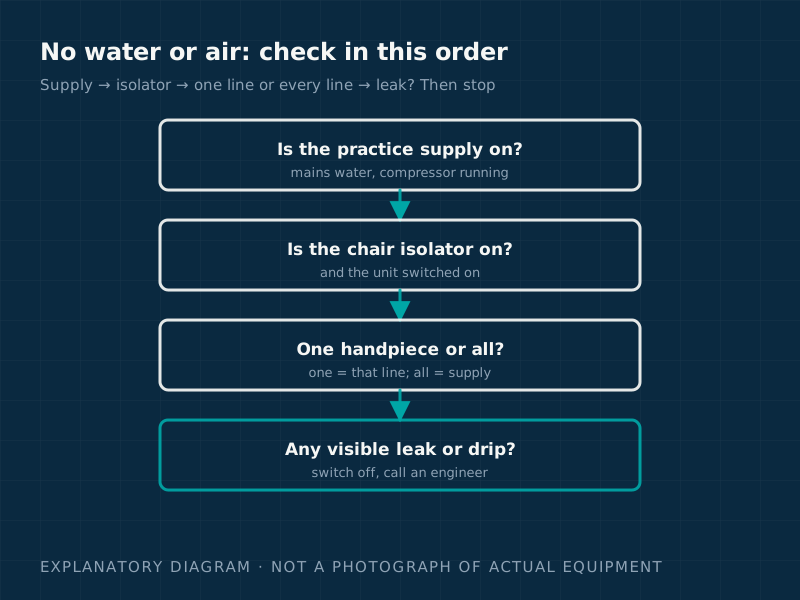
Step 1: one surgery, or all of them?
Before anything else, ask the other rooms. If every surgery has lost air, the compressor or its main line is the place to look. If every surgery has lost water, the incoming supply or a central valve is. If only one room is affected, the plant is almost certainly fine and the fault is in that room's pipework, unit or instrument. This single question saves more wasted time than any other.
Step 2: the plant
Air
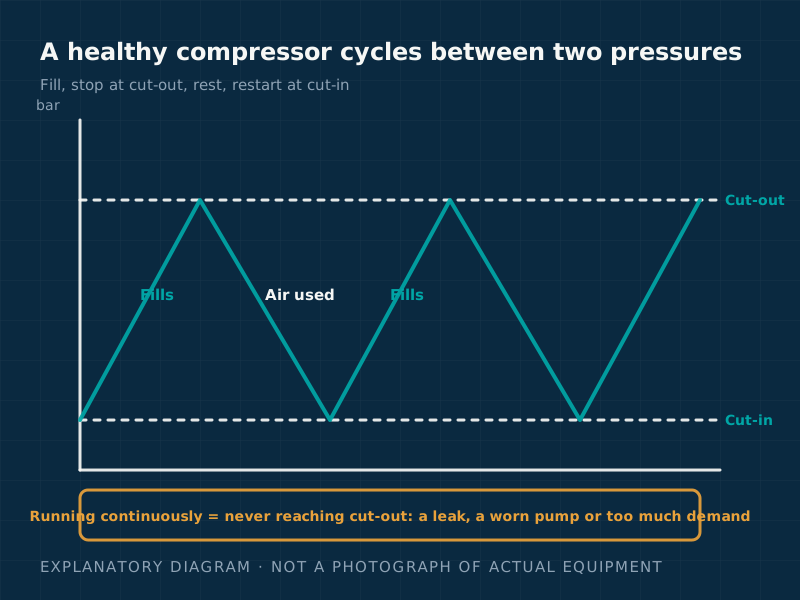
Go to the plant room, or wherever the compressor lives, and look and listen. Is it running? Is the pressure gauge on the receiver showing pressure, or sitting at zero? A compressor that is silent with an empty receiver has a power or control problem; a compressor that is running flat out with a gauge that will not climb is losing air or cannot make enough. Both are covered in dental compressor not starting or losing pressure. Do not adjust the pressure switch, touch the receiver drain, or take covers off. If the compressor is hot, smells of burning or is tripping its supply, isolate it if you can do so safely and report it.
Water
For mains-fed units, confirm the practice has water at a nearby tap and that the main isolation valve for the surgeries is open. Water treatment or filtration units fitted to the supply can also be the point of failure: a clogged filter, a valve on the treatment unit left closed, or a dosing unit in an alarm state. For bottle-fed units, the "plant" is the bottle: is it fitted, full and pressurising when the unit is switched on?
Step 3: the room supply
Each surgery normally has isolation valves for air and water, usually in a box under the unit, in the floor duct or in the cabinetry. They are there for the practice to use and are easy to knock closed during cleaning or cabinet work. Check that both are fully open. If there is a pressure gauge on the air line at the room, note what it reads. If the room's air gauge shows nothing while the plant-room gauge shows full pressure, the fault is in the pipework between the two — a closed valve, a blocked filter or, on older installations, a damaged pipe — and that is an engineer's job.
Step 4: the unit
- Master switch. Most units need the master on before any valve opens. Switch off, wait, switch on.
- Water selector. Units with both mains and bottle supply have a selector; make sure it is set to the source you are using.
- Bottle pressurising. On bottle systems you should hear a brief hiss as the bottle pressurises. No hiss means no air is reaching the bottle, so the problem is upstream of the water, not the water itself.
- Unit filters. Many units have an in-line water filter and an air filter or water separator under the unit. These clog gradually; a room that has been "getting weaker for weeks" is a filter until proven otherwise. Look at any filter bowl you can see without disturbing anything. Cleaning or replacing a filter is a job for staff only where the manufacturer's instructions describe it as a user task; otherwise it is one for the engineer.
- Handpiece selection. Lifting a handpiece from its holder is what opens the supply to it. A holder switch that has stuck, or a holder that does not register the handpiece, gives a dead instrument on a live unit.
Step 5: the instrument
If some instruments work and one does not, the fault is in that instrument or its tubing. Swap the handpiece to another coupling. Check the coupling is fully seated and its O-rings are intact. On the three-in-one, check the tip is pushed home and the tip seal is not split. Check the spray and coolant controls on the unit or foot control: a coolant that has been turned to "off" or a spray control wound shut is a common cause of "no water at the handpiece" on a unit that is otherwise fine.
Symptom table
| Symptom | Where to look first |
|---|---|
| No air in any surgery | Compressor, receiver gauge, main air valve |
| No water in any surgery | Incoming supply, main valve, water treatment unit |
| No air or water in one surgery only | Room isolation valves, unit master switch |
| Air but no water in one surgery | Water valve, selector, bottle, unit water filter, coolant control |
| Water but no air in one surgery | Room air valve, unit air filter or regulator |
| Weak air or water, getting worse over weeks | Filters at the unit or the room |
| One handpiece dead, others fine | Coupling, O-rings, tubing, holder switch |
| Three-in-one gives air but no water | Tip seal, syringe water valve |
| Everything fine, then cuts out under load | Compressor cannot keep up: leak or capacity |
Air but no water, water but no air
These two are worth separating because the supplies share only the last few centimetres of tubing. Air without water is a water-side problem: valve, selector, bottle, filter or coolant control. Water without air is an air-side problem, and if it is only one surgery, the room air valve or the unit's air regulator is the usual answer. If it is every surgery, it is the compressor.
A unit that has air but very weak water, with a bottle system, is often a bottle that is not sealing: the air that should pressurise it is escaping around the cap.
What not to do
- Do not adjust the regulator or pressure switch on the compressor. The cut-out pressure and the safety valve are set together.
- Do not take unit covers off to reach internal valves or filters.
- Do not blow through tubing or couplings with the three-in-one to "clear" them; it can push debris deeper.
- Do not run handpieces without coolant to get through a session. Overheating damages the handpiece and can harm the patient.
What to tell the engineer
Which surgeries are affected; whether air, water or both are missing; what the plant-room gauge and any room gauge read; whether it started suddenly or faded; what the bottle does when the unit is switched on; and anything that changed recently, such as cabinet work, a deep clean, new equipment or a power cut. That description usually lets us arrive with the right filters, valves and seals.
When to stop and call an engineer
Stop at the first stage you cannot clear from the outside. If the supply stops at the plant, you need a compressor engineer: see dental compressor servicing. If it stops at the room or the unit and the valves are open, it is a chair-side repair: see dental equipment repairs, and use report a breakdown to describe what you found at each step. Rooms that keep losing supply are usually overdue for dental chair servicing, where filters, regulators and holder switches are checked as a matter of course. Isolate any equipment that smokes, sparks, overheats or leaks near its electrics, and do not continue using equipment you believe may be unsafe.
This article is general guidance for dental practices. It does not replace the manufacturer's instructions for your specific equipment, is not a statement of your regulatory position, and is not a substitute for an engineer examining the machine. If equipment smokes, sparks, overheats or leaks near electrical parts, isolate it and do not use it until it has been checked.
Sources
- Manufacturer operating and maintenance instructions for the installed chair or treatment centre — Equipment manufacturer (accessed 9 September 2026)
- Manufacturer operating and maintenance instructions for the installed compressor and dryer — Equipment manufacturer (accessed 9 September 2026)
- Health Technical Memorandum 01-05: Decontamination in primary care dental practices — NHS England (accessed 9 September 2026)
- Pressure systems at work: a brief guide to safety (INDG261) — Health and Safety Executive (accessed 9 September 2026)