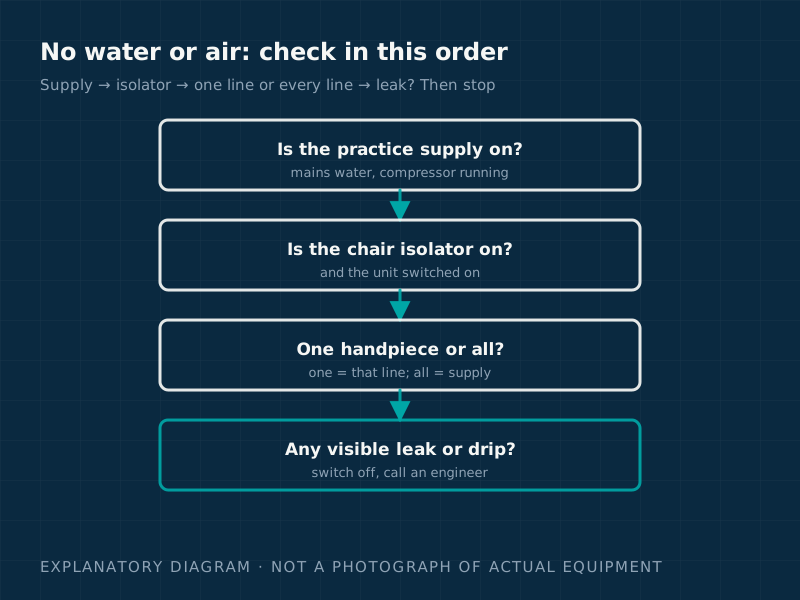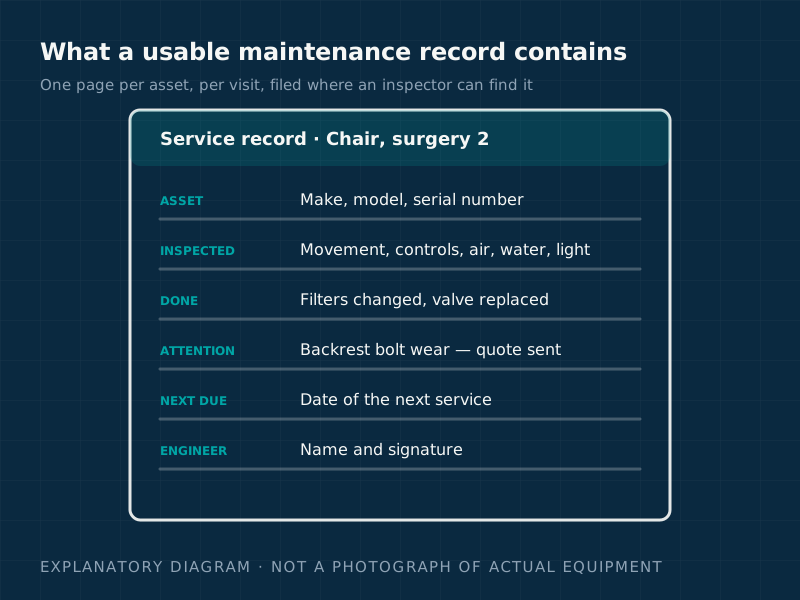
Short answer: a dental compressor that will not start has a power, overload or control problem. One that starts but cannot reach or hold pressure is losing air or cannot make enough. The practice can safely look, listen, read the gauge and check the isolator is on. Everything else — controls, overloads, covers, anything on the receiver — is for an engineer. Drain the receiver only if the manufacturer's daily routine makes that a user task.
Before you start: the safe boundary
A compressor is a pressure system and an electrical machine. The receiver holds air under pressure, the head runs hot, and the motor and control gear are at mains voltage. The practice can safely look, listen, read the gauge, confirm the isolator is on and note any codes on the panel. The practice does not adjust the pressure switch, regulator or safety valve, does not loosen any fitting, does not reset a motor overload unless the manufacturer's instructions describe that as a user action (and then once only), and does not take covers off. Draining the receiver is a user task only where the manufacturer's daily routine describes it and someone in the practice has been shown how. If the compressor smells of burning, is smoking, is too hot to rest a hand near, or trips its supply, switch it off at its isolator if that can be done safely and do not run it again until it has been examined. Do not continue using equipment you believe may be unsafe.
It will not start at all
Power
Confirm the isolator or switched spur is on and the breaker at the consumer unit has not tripped. Plant-room isolators get switched off during cleaning, building work and electrical testing more often than you would expect. A tripped breaker may be switched back on once. If it trips again, leave it off; a motor that repeatedly trips its supply has a winding, capacitor or wiring fault.
Thermal overload
Most compressor motors have a thermal overload that cuts the motor if it overheats. On many machines it clears itself once the motor has cooled, which can take some time in a warm plant room; on others there is a manual button, which the practice uses only if the manufacturer's instructions say the user may, and only once. Either way the question is why it operated: poor ventilation, a hot plant room, a failing capacitor, a head that is struggling, or a run time that is simply too long for the machine. Clearing it and walking away treats the symptom.
Pressure switch
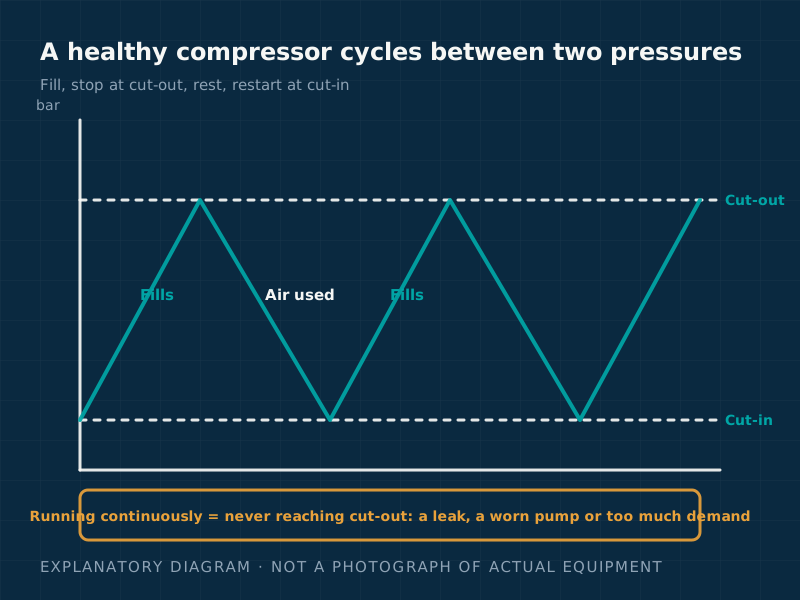
The compressor starts when the receiver pressure falls to the cut-in setting and stops at cut-out. If the gauge shows pressure between the two, the compressor is not supposed to be running; use some air in a surgery and see whether it starts. If the gauge shows zero and the compressor stays silent with power confirmed, the pressure switch, its contacts or the control circuit are suspect. Do not adjust the switch.
Motor and capacitor
A hum without rotation, or a motor that tries to start and stalls, usually means a failed start capacitor or a seized head. Switch it off at the isolator. Leaving a stalled motor energised damages the windings quickly.
Dryer and controls
Compressors fitted with a membrane or refrigerant dryer, and those with electronic controllers, can be held off by the controller: a dryer fault, a sensor fault or an alarm condition. Note any indicator lights or codes on the panel before doing anything else, and do not clear an alarm to get the compressor going.
It starts but trips or stops early
A compressor that runs for a short time and then stops on its overload is overheating or overloaded. Common reasons are a blocked intake filter, a plant room without enough airflow, a head with worn valves that works harder for less output, or a non-return valve that lets receiver pressure back onto the head so that it has to start against load. All of these are engineer items, but the practice can note the pattern: how long it runs, how hot the room is, and whether it has become worse over weeks.
It runs but cannot reach or hold pressure
Air leaks
The most common cause. Air escapes from fittings, the receiver drain valve, a cracked hose, a surgery left with a handpiece selected, or an automatic drain that is stuck open. With the surgeries idle and the plant room quiet, listen: a hiss is a leak. Leaks at the surgeries show up as a compressor that cycles frequently overnight when nobody is using air. See why a dental compressor runs continuously for the wider picture.
Drain valve
Receivers collect condensate that must be drained. An automatic drain that has failed open leaks continuously; a manual drain left slightly open does the same. Draining the receiver is a user task only where the manufacturer's daily routine describes it and someone in the practice has been shown the procedure for that machine. Nothing else on the receiver is touched, and no fitting is loosened, by anyone other than an engineer.
Non-return valve and head valves
The non-return valve stops receiver air flowing back to the head when the compressor stops. When it fails, the compressor starts under load, may stall or trip, and air can be heard escaping through the unloader. Worn head valves and piston rings reduce output, so the compressor runs longer to achieve less. Both are internal and both are engineer repairs.
Dryer purge
Membrane dryers use a small continuous purge of dry air; refrigerant dryers drain condensate. A purge that has become excessive, or a dryer drain stuck open, uses air the surgeries never see.
Reading the gauge
The receiver gauge tells you more than most people realise. Note the reading when the compressor stops (cut-out) and when it starts (cut-in). Then note how long it takes to climb between the two with no surgeries in use, and how long it takes to fall with none in use. A slow climb means low output; a fast fall with no demand means a leak. Those two observations, given to an engineer over the phone, often identify the problem before the visit.
Symptom table
| Symptom | Likely cause | Practice action |
|---|---|---|
| Silent, gauge at zero, isolator on | Breaker, overload, pressure switch, control | Check the breaker; note codes; report |
| Hums, does not turn | Capacitor or seized head | Switch off at the isolator; report |
| Runs briefly then stops, restarts later | Thermal overload: ventilation, filter, valves | Note run time and room temperature; report |
| Runs, gauge climbs slowly | Worn valves or rings, blocked intake, leak | Listen for leaks; report |
| Runs, gauge will not climb at all | Large leak, failed non-return valve, drain open | Listen; look at whether the drain is visibly open; report |
| Reaches pressure but drops quickly at rest | Leak in receiver, pipework or a surgery | Close the surgery isolation valves one at a time to narrow it down; report |
| Cycles every few minutes overnight | Small leak somewhere on the system | Report for a leak check |
| Trips the supply repeatedly | Electrical fault | Leave off; report |
Keeping the practice running
If the compressor can hold some pressure, closing the isolation valves to unused surgeries reduces demand and can keep one or two rooms working while you wait. If it cannot hold pressure at all, air-driven handpieces are out of action and the practice should follow its contingency plan. Electric micromotor handpieces on some units do not depend on compressed air, but the three-in-one and many other functions do.
When to stop and call an engineer
Stop and call if the compressor is silent with power confirmed, hums, trips, cannot reach pressure or loses it at rest, or if anything on it needs more than a switch, a gauge reading or the manufacturer's daily routine. Use report a breakdown and give the gauge readings and any codes. Overloads, pressure switches, capacitors, non-return valves, drains and head service kits are the everyday work of dental compressor servicing, and most of them are caught early by planned servicing rather than a breakdown call. A compressor that is regularly tripping or losing output on an older machine may also be a repair or replace question. Isolate any compressor that smokes, sparks, overheats or leaks near its electrics, and do not continue using equipment you believe may be unsafe.
This article is general guidance for dental practices. It does not replace the manufacturer's instructions for your specific equipment, is not a statement of your regulatory position, and is not a substitute for an engineer examining the machine. If equipment smokes, sparks, overheats or leaks near electrical parts, isolate it and do not use it until it has been checked.
Sources
- Manufacturer operating and maintenance instructions for the installed compressor and dryer — Equipment manufacturer (accessed 9 September 2026)
- Pressure systems at work: a brief guide to safety (INDG261) — Health and Safety Executive (accessed 9 September 2026)
- Safety of pressure systems: Pressure Systems Safety Regulations 2000 Approved Code of Practice (L122) — Health and Safety Executive (accessed 9 September 2026)
- Electricity at Work Regulations 1989: guidance on regulations (HSR25) — Health and Safety Executive (accessed 9 September 2026)