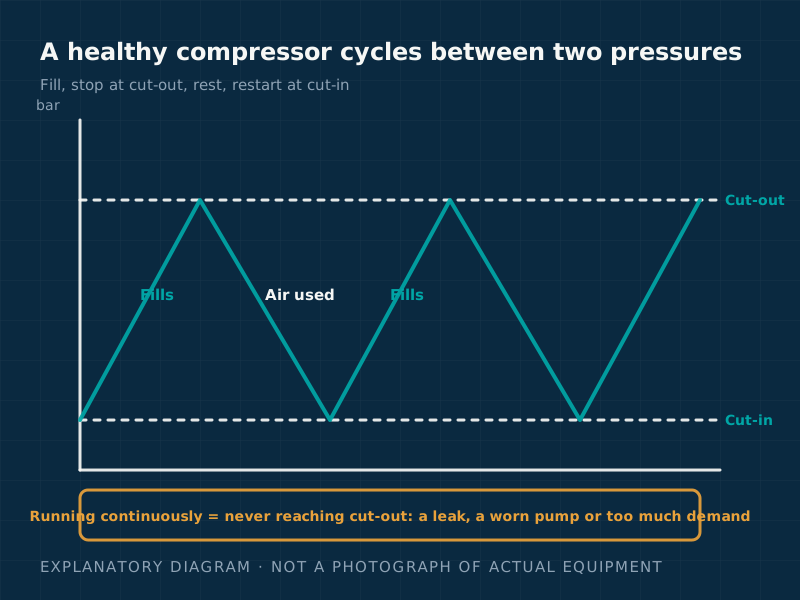
Short answer: a dental compressor should run in cycles: start at cut-in, stop at cut-out, rest. One that never stops, or runs far longer than it rests, is losing air, cannot meet the demand, or has a control fault. It is wearing out faster and pushing warm, wet air into the surgery lines. Note when it runs and call an engineer; if the safety valve is lifting, isolate it and call now.
What normal looks like
Every compressor has a duty cycle: the proportion of time it is designed to run. Dental compressors are sized so that, during a normal session, they run for a period, reach cut-out, and rest for longer than they ran. Overnight and at lunchtime, with no air being used, they should not start at all. If you can hear the compressor from reception all afternoon, or it is still cycling at eight in the evening, something is wrong.
Two things are worth noting from the plant room with the surgeries idle: how long it takes the gauge to climb from cut-in to cut-out, and how long it takes to fall back with nothing in use. A healthy system climbs steadily and, once stopped, holds its pressure with only a slow drift over many hours.
The causes
Air leaks
By far the most common. Air escapes from pipe fittings, the receiver drain, a cracked flexible hose, a dryer purge that has failed, a surgery unit with a stuck holder valve, or a coupling with a perished O-ring. Each leak on its own may be small; together they can equal a surgery in constant use. A compressor that cycles through the night when nobody is in the building is describing a leak precisely.
Demand has outgrown the compressor
Practices grow. A compressor sized for two surgeries is asked to feed four; a new unit with air-driven scalers and a high-demand three-in-one is added; a decontamination room with an air-driven instrument is plumbed in. The compressor is not faulty, but it can never rest. Sizing is a matter of matching the compressor's output to the number of surgeries and the equipment in them, and the manufacturer's data sheet is the reference.
Worn head valves or piston rings
As the head wears, each stroke delivers less air. The compressor runs longer to produce the same amount, and the run time creeps up over months. Practices often notice this as the compressor "getting louder" or the plant room "getting warmer" rather than as continuous running.
Restriction on the way in or out
A blocked intake filter starves the head; a saturated or blocked dryer restricts the outlet. Either reduces effective output.
Control fault
If the pressure switch never registers cut-out, or its contacts have welded, the compressor will run until the safety valve lifts or the overload trips. A safety valve that is lifting is a serious sign: it means the control that should have stopped the compressor has failed and the last line of defence is doing its job. Isolate the compressor if that can be done safely and call.
Heat
Compressors in cupboards, lofts and unventilated plant rooms run hot. Hot air is less dense, so output falls; the motor and head then run longer and get hotter still. In summer this can be the whole story.
Why it matters
- The machine wears out. Oil-free heads, which most dental compressors use, have a finite service life measured in running hours. A compressor running twice as long as it should is using its life twice as fast.
- Moisture reaches the surgeries. Dryers are sized for a duty cycle. A compressor that never rests overwhelms its dryer, and warm, wet air goes down the lines. Moisture in the air supply corrodes handpiece bearings, puts water in the three-in-one air, and works against the clean, dry air that dental units and handpieces are designed to run on.
- Overheating trips and burn-outs. The thermal overload will eventually operate, usually mid-session. Repeated overheating shortens motor life and can end in a winding failure, which on many machines means a new compressor.
- Energy. A compressor running all day costs money every day it runs, which is the easiest number for a practice owner to feel.
- Pressure-system safety. A compressor that is being run to its limits, with a safety valve lifting, is exactly the situation the Pressure Systems Safety Regulations exist to prevent. See compressor servicing and the Pressure Systems Safety Regulations.
What is safe to check
- Whether the compressor cycles with all surgeries idle. If it does, there is a leak.
- Whether you can hear air escaping anywhere in the plant room or under any unit.
- Whether every surgery's unit is switched off at the end of the day. Units left on with a handpiece lifted will consume air all night.
- Whether the plant room is noticeably warmer than the rest of the building, or the compressor is too hot to hold a hand near.
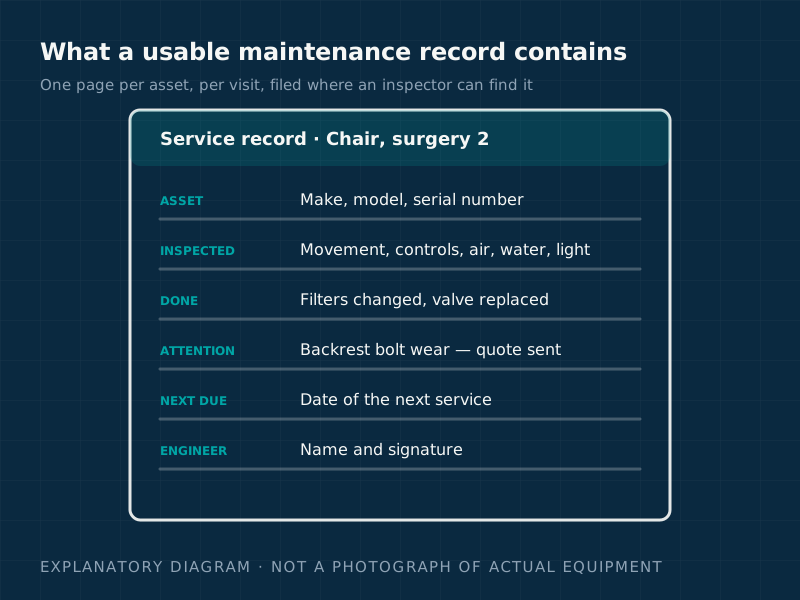
- The last service date on the compressor's label or in the service record.
- Whether anything has changed: a new surgery, new equipment, building work, a new dryer.
That is where the practice stops. Do not adjust the pressure switch, tamper with the safety valve, drain the receiver unless the manufacturer's daily routine makes that a user task, loosen any fitting, or run the compressor with a cover off. If it smokes, sparks or overheats, isolate it if that is safe and do not use it until it has been examined. Do not continue using equipment you believe may be unsafe.
Leak, wear or size? A rough guide
| Observation | Points to |
|---|---|
| Cycles overnight with all units off | Leak on the plant side or pipework |
| Cycles overnight only when units are left on | Leak at a unit, holder valve or coupling |
| Holds pressure at rest, but runs constantly in session | Demand exceeds capacity, or head output has fallen |
| Run time has crept up over months, sound has changed | Head wear, filter restriction |
| Started suddenly after building or plumbing work | Damaged pipe or fitting |
| Safety valve lifting or hissing | Control fault: isolate and call |
| Worse in hot weather | Ventilation |
Repair or replace?
Leaks, drains, filters, non-return valves and pressure switches are repairs. A head service kit restores output on a compressor that is otherwise sound. Repeated output problems on an older machine, a burnt-out motor, or a compressor that was never big enough for the practice as it now is point to replacement, ideally planned and sized properly rather than bought in a hurry after a failure. A written condition assessment of the compressor, its dryer and its receiver, set against its service history and the practice's actual demand, is the right basis for that decision.
When to stop and call an engineer
Stop and call if the compressor cycles with the practice idle, runs continuously in session, is hot, or if the safety valve is lifting: in that last case isolate it first, if that is safe. A leak check, output test and pressure control check are part of dental compressor servicing; use report a breakdown if it has stopped or tripped. If the answer turns out to be capacity, we can size a replacement against the surgeries you actually have and plan the changeover under equipment supply and installation. Continuous running is also one of the clearest reasons to put a compressor on a planned maintenance schedule rather than waiting for the overload to make the decision for you. Do not continue using equipment you believe may be unsafe.
This article is general guidance for dental practices. It does not replace the manufacturer's instructions for your specific equipment, is not a statement of your regulatory position, and is not a substitute for an engineer examining the machine. If equipment smokes, sparks, overheats or leaks near electrical parts, isolate it and do not use it until it has been checked.
Sources
- Manufacturer operating and maintenance instructions for the installed compressor and dryer — Equipment manufacturer (accessed 9 September 2026)
- Pressure systems at work: a brief guide to safety (INDG261) — Health and Safety Executive (accessed 9 September 2026)
- Health Technical Memorandum 01-05: Decontamination in primary care dental practices — NHS England (accessed 9 September 2026)