Short answer: a routine compressor service keeps the machine to the manufacturer's schedule and produces a service report. The Pressure Systems Safety Regulations 2000 (PSSR) place a separate statutory duty on the user or owner of a qualifying pressure system: hold a written scheme of examination and have the system examined by a competent person in accordance with it. One does not replace the other, and there is no single document called a "PSSR certificate".
Three different things
Practices, and some suppliers, run these together because they all involve the same machine. It helps to separate them by purpose.
| Aspect | Routine servicing | Written scheme of examination | Periodic examination |
|---|---|---|---|
| Purpose | Keep the compressor reliable and within the manufacturer's maintenance schedule | Define which parts of the pressure system are to be examined, how and how often | Examine those parts to confirm the system is safe to continue in use |
| Basis | Manufacturer's instructions; good engineering practice | PSSR 2000, Regulation 8 | PSSR 2000, Regulation 9 |
| Who | A dental equipment engineer | Drawn up or certified by a competent person | A competent person |
| Output | Service report for that asset, with the next service date | The written scheme itself | Report of examination, with any defects and the date by which the next examination is due |
| Interval | Per manufacturer, typically annual | Reviewed when the system changes or the competent person advises | As set in the written scheme |
What routine servicing covers
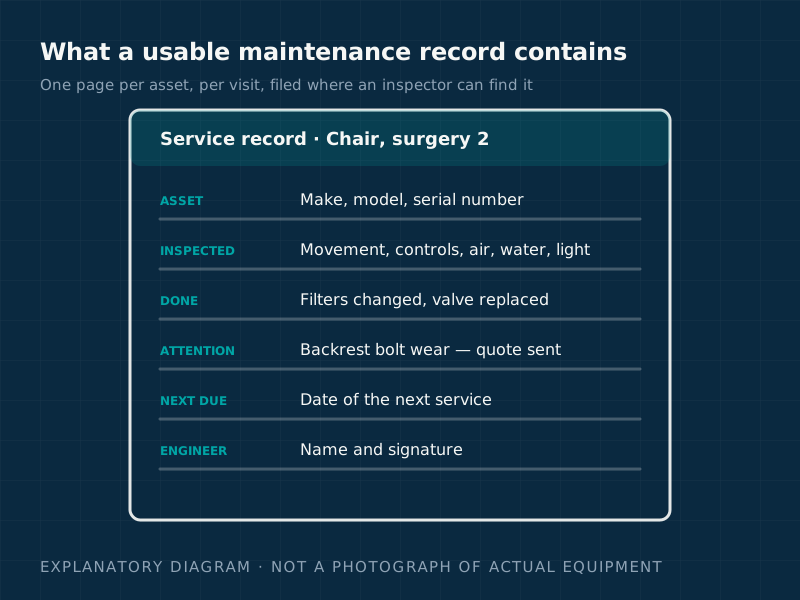
A service follows the manufacturer's schedule for the model. On a typical dental compressor that means the intake filter, the service kit for the head, the dryer and its filters or membrane, the receiver drain and any automatic drain, a leak check across the system, a check of the pressure switch and safety valve function, motor and electrical connections, and a run test with the cut-in, cut-out and recovery time recorded. The report lists what was done, what was found, what is recommended and when the next service is due. It is matched to the asset by make, model and serial number, which matters later.
Servicing is what keeps the machine out of the not starting and running continuously articles. It says nothing, on its own, about the statutory position.
What PSSR requires
PSSR applies to pressure systems containing a "relevant fluid", and compressed air above a modest pressure is one. The Approved Code of Practice, HSE document L122, explains which systems are within scope and which are excepted, based on pressure and the stored energy in the system. Whether a particular dental compressor and receiver falls inside the written-scheme requirement depends on the receiver's volume and working pressure. Many dental installations do; some small ones may be excepted. That determination should be made by a competent person against the actual installation, not assumed from the size of the practice.
For a system in scope, the user or owner must:
- have a suitable written scheme of examination drawn up or certified by a competent person before the system is used;
- have the system examined in accordance with the scheme, at the intervals it sets;
- act on any defects and imminent-danger reports;
- ensure the system is properly maintained and operated within safe limits;
- keep the records: the scheme, the reports of examination and the safe operating limits.
The maintenance duty and the examination duty are both there, and they are different. Servicing satisfies the first. Only the written scheme and the examination satisfy the second.
Nothing in PSSR asks practice staff to test the safety valve, adjust the pressure switch or look inside the receiver themselves. Those checks belong to the engineer at a service and to the competent person at an examination. The practice's part is to keep the machine within the limits on its data plate, act on what the reports say, and keep the paperwork.
The competent person
In PSSR the competent person is the person or organisation with the knowledge, experience and independence to draw up the scheme and carry out the examination. For simple systems like a dental compressor this is commonly an engineering inspection body, often arranged through the practice's insurer. A dental equipment engineer is not automatically a competent person for PSSR purposes, and Dynamo Dental does not describe itself as one unless that competence has been verified and stated in the quotation for a specific piece of work.
Common misunderstandings
- "The compressor was serviced, so we are covered." The service report evidences maintenance. It is not the written scheme or the report of examination.
- "We have the PSSR certificate." There is no such single document. The evidence is a written scheme plus a report of examination, each identifying the system by serial number and each with a date.
- "The safety valve was checked, so the examination is done." A safety-valve check is part of a service. The examination is carried out by the competent person to the scope in the scheme.
- "Our supplier does all of this." Perhaps, but check which of the three items your supplier's paperwork actually is. A service invoice that mentions "pressure vessel inspection" without a written scheme and a report of examination from a competent person is a service invoice.
- "It is the engineer's responsibility." Using a contractor does not move the duty. The user or owner of the system holds it.
What stays with the practice
The practice, as user or owner of the pressure system, is responsible for holding the written scheme, arranging the examination at the interval it sets, acting on any defects, maintaining the system, and keeping the records. Regulators and inspectors, including CQC under Regulation 15, will expect to see that evidence when they look at how equipment is kept safe. Dynamo Dental helps practices organise relevant maintenance records and identify next actions within the agreed scope. The practice remains responsible for ensuring its regulatory duties are met.
Where Dynamo Dental fits
We carry out routine compressor servicing and produce the service report. At each visit we record which examination evidence the practice holds and when the next examination is due, so that the due date does not get lost. Where a practice would like us to, we coordinate a competent person for the written scheme and the examination through a specialist partner, and the quotation states clearly which of these you are buying. We do not describe a service as an examination, and we do not tell a practice that its statutory position is settled.
Records to keep together
- The written scheme of examination: the parts of the system it covers, the nature and frequency of examination, and who certified it.
- Each report of examination, with defects noted, actions taken and the date of the next examination.
- Service reports, filed separately, matched to the same asset by serial number.
- The safe operating limits for the system, usually stated on the receiver's data plate and in the scheme.
- A note of the next due dates for service and for examination, and who is responsible for arranging each.
This is the kind of asset-linked evidence described in dental equipment maintenance records for CQC.
When to stop and call an engineer
If the compressor is due a service, or you do not know when it was last serviced, see dental compressor servicing. If you cannot find a written scheme or a report of examination, or do not know whether your system needs one, equipment records and lifecycle planning is where we help a practice establish what it holds and what is due, and coordinate a competent person where that is agreed. If a report of examination records a defect, act on it before the compressor is used again. If the compressor is hot, the safety valve is lifting, or it is tripping its supply, stop: isolate it if that is safe to do, use report a breakdown, and do not continue using equipment you believe may be unsafe.
This article is general guidance for dental practices. It does not replace the manufacturer's instructions for your specific equipment, is not a statement of your regulatory position, and is not a substitute for an engineer examining the machine. If equipment smokes, sparks, overheats or leaks near electrical parts, isolate it and do not use it until it has been checked.
Sources
- Safety of pressure systems: Pressure Systems Safety Regulations 2000 Approved Code of Practice (L122) — Health and Safety Executive (accessed 9 September 2026)
- Pressure systems at work: a brief guide to safety (INDG261) — Health and Safety Executive (accessed 9 September 2026)
- Regulation 15: Premises and equipment — Care Quality Commission (accessed 9 September 2026)
- Manufacturer operating and maintenance instructions for the installed compressor and dryer — Equipment manufacturer (accessed 9 September 2026)